



Education
Weight 1/5 · 6 indicators

Assessing a family's available income remains important for identifying situations of poverty. However, considering income alone does not reveal all the hardships that can affect people's lives.
Multidimensional poverty broadens this perspective by considering different deprivations that may occur simultaneously. Identifying needs that go beyond income makes it possible to better understand who lives in poverty, which deprivations they face, and how these deprivations combine. This, in turn, makes it possible to identify the issues that require greater attention from public policies.
A family may be above the monetary poverty line and still face significant deprivations, such as inadequate access to healthcare, education, housing, sanitation, or employment opportunities. Similarly, families with similar incomes may have very different living conditions depending on the deprivations they face.
Multidimensional poverty is measured based on these deprivations.

01
The tool
Dozens of countries have already recognized that poverty-related public policies need to take into account people who simultaneously face overlapping deprivations. For this reason, they have adopted national Multidimensional Poverty Indices to guide and measure their public policies.
The Brazilian Federal Court of Accounts (TCU), with the support of OPHI (Oxford Poverty and Human Development Initiative), developed the Multidimensional Poverty Index for Auditing (MPI-A), a tool designed to support audits with broader evidence on the population's living conditions.
The MPI-A analyzes poverty across five dimensions: education, health, housing conditions, vulnerabilities, and employment.
The index measures multidimensional poverty based on the proportion of people considered poor across these different dimensions and the average number of deprivations experienced by these people.
The MPI-A is based on CadÚnico, the Federal Government's registry containing information on nearly 100 million low-income Brazilians who have applied for or receive some form of federal benefit.
02
Click any deprivation to read the condition
Weight 1/5 · 6 indicators
Weight 1/5 · 4 indicators

Weight 1/5 · 3 indicators

Weight 1/5 · 4 indicators

Weight 1/5 · 2 indicators

Education
An individual is considered deprived if they live in a household where at least one member over the age of 18 cannot read and write.
View full table03
Based on CadÚnico data and budgetary information from official management and planning systems for the period from 2016 to 2024, dimensions were defined to capture key deprivations reflecting minimum standards of well-being. These dimensions are education, health, housing conditions, vulnerability, and employment. This set of dimensions was broken down into 19 indicators.
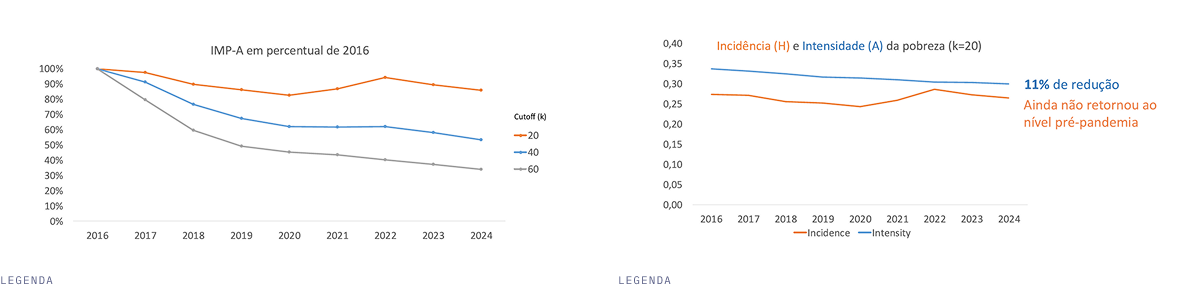
The results showed significant progress over the period. Multidimensional poverty declined by 14.2%, indicating a significant improvement in the conditions of many families, while poverty intensity decreased by 11%, showing that the deprivations experienced by those who remained poor were reduced. However, regional disparities were identified, with the states in the North and Northeast recording the highest levels of multidimensional poverty.
Public spending followed a trajectory of growth and subsequent stabilization, except in 2021, when spending was influenced by the recovery following the impacts of the COVID-19 pandemic. An association was found between the technical efficiency of spending in the Federative Units and its impact on the index, as well as between increased spending and poverty reduction, particularly federal spending on social protection and local spending on healthcare.
The study demonstrated that the MPI-A is a valuable tool for audits, enabling not only the measurement of multidimensional poverty but also the assessment of the effectiveness and efficiency of public policies.
The next steps include consolidating, institutionalizing, and expanding the MPI-A methodology. This involves enhancing the index with new data sources, extending the analysis to other population groups and geographic areas, and disseminating the methodology locally to State and Municipal Courts of Accounts.
Internationally, the TCU has joined forces with other Supreme Audit Institutions that have experience using national MPIs in their audits so that, together, they can develop a guide on multidimensional poverty audits.
Veja abaixo alguns dos resultados obtidos ao longo do levantamento. Processo do TCU: TC 016.821/2025.